
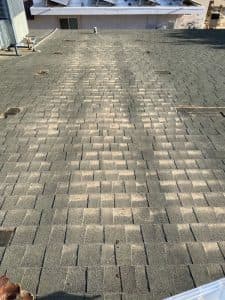
Roof Leaking Under Your Solar Panels? What to Do First
A ceiling stain under a solar array doesn't always mean the panels caused it, but it does mean someone has to look under them. Here's how to narrow down the source, what to write down, and who to call.
“The price was in budget and they were able to accommodate our roofer's schedule.”
Suzette L. · Google Review
“I highly recommend Solar Fix for their caring approach and top-notch service!”
Melissa D. · Google Review
“Very refined process in place here with lots of communication.”
Brian G. · Google Review
The short answer
If you see a water stain, drip or soft spot in the ceiling under your solar panels, don't assume the panels caused it, and don't assume they didn't. Every solar mount goes through the roof, so the mounts are a common place for water to get in. But roofs leak for plenty of other reasons, too.
The first steps are the same either way: protect the inside of the house, take photos, find your solar paperwork, and get someone who can work around the panels to look at the roof. Stay off the roof yourself.
Why solar mounts can leak
Most rooftop systems sit on rails that are bolted to the roof framing. Each bolt makes a hole through the roofing. That hole has to be covered with flashing, a metal or molded piece that sheds water over the hole, plus sealant underneath.
The Building America Solution Center, a U.S. Department of Energy resource, notes that the International Residential Code requires roof penetrations for rooftop PV systems to be flashed and sealed. Its guide for existing roofs recommends checking every roof penetration, including solar panel mounting brackets, for proper flashing and water management details.
When a mount leaks, the cause is usually one of these:
- ▸Sealant with no real flashing. Caulk alone can crack and pull away over time. Roofing industry sources describe sealant-only mounts as a common weak point.
- ▸Flashing installed wrong. Flashing has to tuck under the roofing above it so water runs over it, not into it.
- ▸Broken tiles around a mount. Many Arizona homes with solar have tile roofs. A cracked or slipped tile near a mount can let water reach the layer underneath.
- ▸A mount that missed the rafter or came loose. A loose mount can move in the wind and work the seal open.
Leaks often show up during monsoon season, when a hard storm finds a weak spot that a light rain never did.
Other things that leak near solar panels
Before blaming the panels, look at what else is up there. Roof vents, skylights, valleys where two roof slopes meet, chimneys, and rooftop AC or evaporative cooler units all go through the roof, too. On an older roof, worn underlayment can leak with no solar involved at all.
Water also travels. It can come in at one spot on the roof and show up several feet away on the ceiling. So a stain right under the array is a clue, not proof.
What you can do right now
None of this needs a ladder.
1. Protect the inside. Put a bucket under any drip, move furniture and electronics, and keep people away from a sagging ceiling. 2. Take photos. Photograph the ceiling stain, the attic if you can reach it safely, and the roof from the ground. Note the date and whether it rained. 3. Find your solar paperwork. Look for the installation contract, the installer's name and license number, and any workmanship warranty. Note when the system was installed. 4. Check whether you lease. If you lease your panels or have a PPA, the company that owns the system usually handles repairs to it. Contact them first. 5. Write it down. Keep a simple log of when you noticed the leak, who you called, and what they said.
Don't climb on the roof, walk on the panels, or try to seal anything yourself. The wiring under a solar array can carry power any time the sun is up, and stepping on panels or tiles can crack them.
Who should fix it
A roof leak under solar usually takes two kinds of work: someone to deal with the solar system, and someone to fix the roof.
If the leak is under the panels, some of them usually have to come off so the roof can be reached. That means shutting the system down properly, disconnecting and storing the panels, and then putting them back and testing them once the roof is fixed. Our solar panel removal and reinstall page explains how that works, and roofers can see how we coordinate on our page for removal and reinstall for roofers.
If the leak turns out to be at a mount, the fix may be new flashing and resealing at that spot. If it's the roofing itself, a licensed roofer handles that part. SolarFIX does not do roof replacement, so on a full reroof we work with your roofer.
Who pays for it
This depends on what caused the leak and what your paperwork says.
- ▸Installer workmanship. If the leak comes from how the mounts were installed, start with the installer's workmanship warranty. Contact them in writing and keep a copy.
- ▸The Arizona Registrar of Contractors. If a licensed contractor won't respond, the Registrar of Contractors investigates complaints against licensed contractors. Arizona law generally requires a complaint to be filed within two years after the completion of the specific project, so don't wait if your system is newer.
- ▸Worn-out roofing. If the roof itself is at the end of its life, the repair is usually the homeowner's.
- ▸Storm damage. If a storm caused it, your homeowners insurance may be involved. Our guide to solar panel storm damage in Arizona covers what to document.
If your installer is out of business, you may still need the leak fixed even without anyone to make a claim with. A licensed solar company can handle the solar side of the repair.
When to get help
Get the roof and the solar looked at if:
- ▸You see a new stain, drip or soft spot in a ceiling under or near the array.
- ▸You see broken tiles, loose flashing or a shifted mount from the ground.
- ▸Water shows up after every hard rain in the same spot.
- ▸You're planning a roof repair or replacement and the panels are in the way.
A solar panel inspection can check the mounts, flashing and wiring along with the panels, and if something on the solar side is damaged, the fix goes through solar repair.
The bottom line
A leak under solar panels is a roof problem that happens to have equipment on top of it. Protect the inside, take photos, find your contract, and stay off the roof. Then get the panels lifted where needed so the source can be found and fixed, and keep a record in case the installer, the Registrar of Contractors, or your insurer needs it.
FAQ
Did my solar panels cause my roof leak?+
Maybe, but not always. Every solar mount is a hole in the roof that has to be flashed and sealed, so the mounts are a common suspect. Vents, skylights, valleys, rooftop AC units and old roofing can leak too. Someone has to look at the roof under and around the array to know.
Who pays to fix a leak from solar mounts?+
Start with your installer's workmanship warranty and your contract. If a licensed Arizona contractor did the work, you can also file a complaint with the Registrar of Contractors, which generally has to be filed within two years after the completion of the specific project. If the leak comes from roofing that simply wore out, it's usually the homeowner's repair.
Can a roofer fix the leak without moving the panels?+
Sometimes, if the leak is at the edge of the array. If it's under the panels, some of them usually have to come off so the roof can be reached. That should be done by a licensed solar company so the system is shut down, stored and reconnected properly.
Related: Solar panel removal and reinstall · Solar repair · Solar panel inspection · Removal and reinstall for roofers · Solar panel storm damage in Arizona
Water showing up under your solar?
Send SolarFIX photos of the ceiling stain, the roof from the ground, and your solar contract if you have it. We'll help you figure out whether the panels need to come off and who should handle the repair.