
Brown Spots, Bubbles or Lines on Your Solar Panels? What They Mean
Panels that change color, show thin dark lines, or bubble under the glass are telling you something. Some marks are mostly cosmetic. Others point to damage that can cost production or become a safety issue. Here's how to tell them apart.
“The price was in budget and they were able to accommodate our roofer's schedule.”
Suzette L. · Google Review
“I highly recommend Solar Fix for their caring approach and top-notch service!”
Melissa D. · Google Review
“Very refined process in place here with lots of communication.”
Brian G. · Google Review
The short answer
Most marks you see on a solar panel are inside the panel, not on top of it. That means you can't wash them off, and it also means they're worth a closer look.
Some of them are slow, mostly cosmetic aging. Others are signs of cracked cells, moisture getting in, or a part of the panel running hotter than it should. The way to tell the difference is to compare what you see with what your system is producing, and to have a technician check anything that looks burned, bubbled, or broken.
Why this matters more in Arizona
Panels in Arizona spend a lot of hours in strong sun and high heat. That's great for production, but heat and UV are also what age the materials inside a panel. A panel that's been on a Phoenix roof for 10 or 15 years has had a harder life than the same panel in a mild climate.
Heat also matters for safety. A part of a panel that's running hot is easier to ignore on a roof you never look at, and harder to ignore once it's damaged the panel.
The common marks and what they usually mean
Yellow or brown discoloration
A panel that looks yellow, tan, or brown across the cells usually has an aging encapsulant. That's the clear layer that holds the cells in place under the glass. As it breaks down, less light reaches the cells.
NREL researchers found that encapsulant discoloration was a common degradation mode in older PV panels. Newer panels show it less often, but it still turns up on older systems, especially ones that have spent years in strong sun.
Browning usually happens slowly. On its own, it's not an emergency, but it does cost production over time. If several panels look brown and your production has dropped, it's worth having the system tested.
Snail trails
Snail trails are thin, dark, wandering lines across the cells. They look like a snail crawled across the panel.
IEA PVPS, an international research group on solar reliability, describes snail tracks as a discoloration of the silver paste on the front of the cell. They tend to follow narrow cracks in the cells that you usually can't see. The research says the discoloration itself has no influence on module performance, but the cell cracks underneath it can reduce module power.
A 2025 IEA PVPS annex says snail tracks typically appear 3 months to 1 year after installation. So if you see them on a newer system, it's worth mentioning to whoever installed it.
Bubbles or peeling under the glass
Bubbles, cloudy patches, or areas where the layers look like they're separating are called delamination. Delamination is on the IEA PVPS list of the most common panel failures, along with junction box failure, cell cracks, snail tracks, and burn marks.
Delamination matters because it can let moisture into the panel. Moisture and electricity don't mix well, so a panel that's bubbling or peeling should be inspected, not just watched.
Burn marks and hot spots
Brown or black scorch marks on a cell, on the back of the panel, or near the junction box are the most urgent thing on this list.
A hot spot is a part of a panel that runs much hotter than the rest of it. Causes include cracked cells, bad internal connections, or a failed part inside the panel. NREL's research found that newer panel problems have been dominated by hot spots and internal circuitry discoloration, and notes that hot spots can be a safety issue.
Many hot spots can't be seen with your eyes until they've already left a mark. Technicians often find them with a thermal camera while the system is running in full sun.
If you see a burn mark, don't touch the panel or the wiring. Call a licensed solar company. If you see smoke or fire, call 911.
Cracked or shattered glass
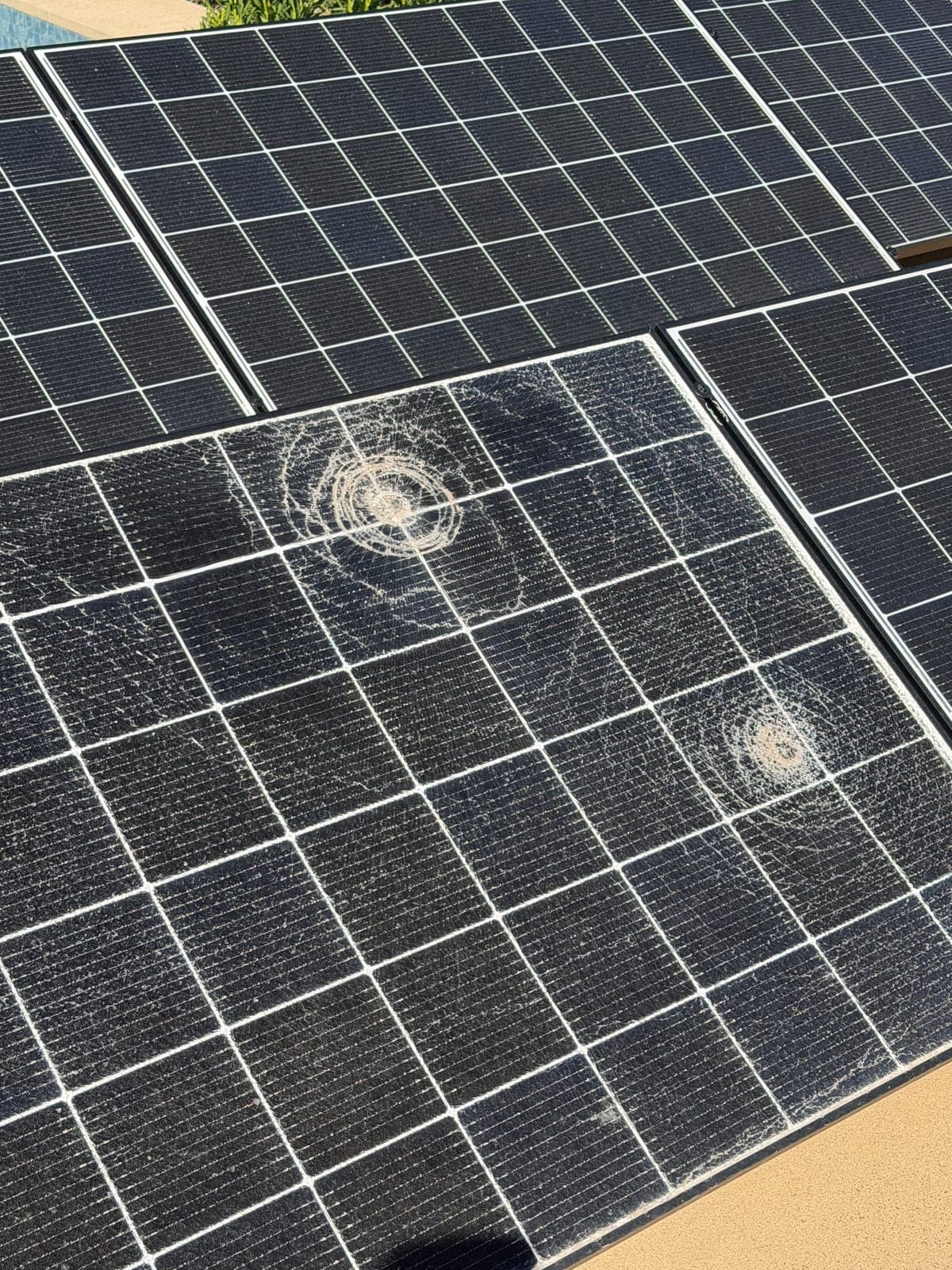
Cracked glass usually comes from an impact: hail, a falling branch, a dropped tool during roof work, or debris in a storm. Even a small crack can let water in over time. A cracked panel generally needs to be checked and, in many cases, replaced. Our solar panel replacement page explains how that works.
What you can safely check yourself
You don't need to get on the roof to do any of this.
- ▸Take photos from the ground. Zoom in on anything that looks discolored, lined, bubbled, or cracked. Note which panels they are.
- ▸Check your monitoring app. Look for one panel or one section producing less than the rest, or a drop in total production compared with the same month last year.
- ▸Compare your bills. A higher bill in the same season, with no change in how you use power, can be a sign that production has dropped.
- ▸Find your panel brand. It's often on your installation paperwork or in your monitoring app. You'll need it for any warranty claim.
Don't climb on the roof, walk on the panels, or try to clean or open anything. Stepping on panels can crack the cells inside, which can cause the very problems you're trying to find.
When to get the panels inspected
Have a professional take a look if:
- ▸You see any burn marks, melted spots, or scorching.
- ▸Panels are bubbling, peeling, or have cracked glass.
- ▸Your monitoring shows one panel or string producing noticeably less than the others.
- ▸Production has dropped and you can't explain it with weather or dust.
- ▸You're buying or selling a home with solar and want to know what condition the panels are in.
A solar panel inspection looks at the panels, mounting, wiring, and production together, so a mark on the glass gets checked against how the system is actually performing. If a panel turns out to be failing, the fix is handled through solar repair or replacement. If you'd like someone keeping an eye on the system over time, a solar panel maintenance plan includes regular checks.
If your installer is gone or your system is leased
If you lease your panels or have a PPA, the company that owns the equipment usually handles repairs to it. Check your contract first.
If your installer is no longer around, the panel manufacturer's warranty may still apply, depending on the brand and the panel's age. A written inspection report with photos and production data can help when you make a warranty claim.
The bottom line
Brown panels, snail trails, bubbles, and burn marks all come from inside the panel, and none of them wash off. Browning is usually slow aging. Snail trails often point to cracked cells. Bubbles and cracked glass can let moisture in. Burn marks are the one to act on right away. Take photos, check your production, and have a licensed solar technician inspect anything that looks burned, bubbled, or broken.
FAQ
Are snail trails on solar panels a problem?+
The lines themselves aren't the main concern. IEA PVPS research describes them as a discoloration that tends to follow small cracks in the cells, and those cracks can reduce power. It's worth checking your production and having the panel looked at, especially if output has dropped.
Can I clean off brown spots or discoloration?+
Usually not. Browning and snail trails are inside the panel, under the glass, so cleaning won't change them. Dust and bird droppings on top of the glass are a different issue and do wash off.
Is a discolored panel covered by warranty?+
It depends on the manufacturer, the panel's age, and how much power it's lost. Check the panel brand and your warranty paperwork. If your installer is no longer in business, the manufacturer's warranty may still apply.
Related: Solar panel inspection · Solar panel replacement · Solar repair · Solar panel maintenance
Seeing marks on your solar panels?
Send SolarFIX a photo of what you're seeing, your panel brand if you know it, and what your monitoring app shows. We'll help you figure out whether it needs an inspection.