
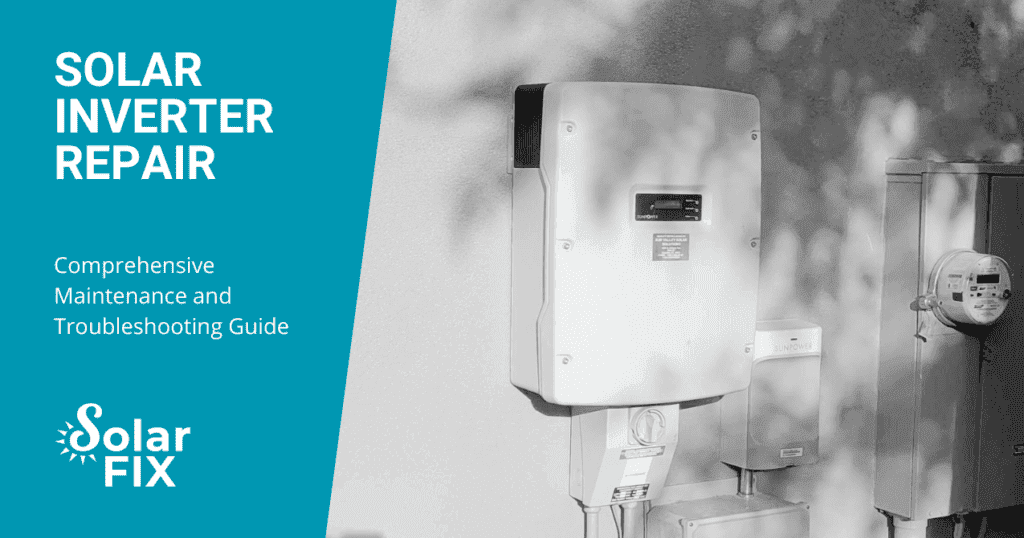
Solar Inverter Showing an Isolation Fault? What It Means and What to Do
An isolation fault is one of the inverter errors worth taking seriously. It often shows up on damp mornings or after a storm, and it sometimes clears by itself. Here's what it means, why it comes and goes, and why it still needs a technician.
“The price was in budget and they were able to accommodate our roofer's schedule.”
Suzette L. · Google Review
“I highly recommend Solar Fix for their caring approach and top-notch service!”
Melissa D. · Google Review
“Very refined process in place here with lots of communication.”
Brian G. · Google Review
The short answer
An isolation fault means your inverter measured too little insulation between the DC side of your solar system and ground. In plain terms, some of the power from your panels may be leaking where it shouldn't, through a damaged cable, a wet connector or a failing part.
The inverter stops producing when it sees this, which protects the system. If the fault comes back, or doesn't clear, it needs a technician to find the cause. Don't touch the panels or wiring yourself.
What the inverter is checking
Before it starts each day, and while it runs, the inverter checks how well the DC wiring is insulated from ground. If that resistance drops below a set limit, it reports an error and stays off.
SolarEdge, for example, says its inverters show an isolation error when they detect a total combined isolation resistance of less than 600k Ω in single phase inverters, or 1M Ω in three phase inverters. Other brands use different names, such as "ground fault," "insulation fault" or "Riso," but the idea is the same.
Why it matters
Ground faults aren't just an annoyance. A field guide prepared for the National Renewable Energy Laboratory says ground faults and arc faults are the two most common reasons for fires in photovoltaic arrays. Sandia National Laboratories research on ground fault detection makes a related point: no single trip setting fits every system, which is why a fault the inverter flags deserves a real look.
That's why the right move is to find the cause, not just keep restarting the system.
Why it often shows up in the morning or after rain
A lot of isolation faults follow the weather. SolarEdge notes that an isolation fault may disappear and recur after a short period, especially if it is caused by morning moisture.
Here's what's usually happening. Dew, rain or monsoon humidity gets into a spot where the insulation is already damaged: a cracked connector, a cable rubbed through on the racking, or a panel with a failing seal. The wet spot lets current leak to ground, and the inverter shuts down. As the sun dries things out, the reading climbs back over the limit and the system starts again.
So a fault that clears by noon is still a fault. The damage is usually still there, and it tends to return with the next storm.
Common causes
SolarEdge lists the usual sources of leakage to ground as modules with defective module isolation, unshielded wires, defective Power Optimizers, or an inverter internal fault. In the field, that often looks like:
- ▸Damaged cables. Wires rubbed on sharp racking edges, pinched under clamps or left hanging on the roof can wear through over time.
- ▸Wet or failed connectors. The plugs that join panels together can crack, loosen or let water in.
- ▸Panel problems. A panel with a cracked back sheet, failed junction box or broken seal can leak.
- ▸Critter damage. Animals nesting under panels can chew or damage exposed wiring. Our page on birds nesting under solar panels covers that side of things.
- ▸Optimizer or inverter faults. Sometimes the electronics themselves are the problem.
What you can safely check
None of this requires opening equipment or going on the roof.
1. Write down the exact error. Take a photo of the inverter screen or the app alert, including any error code. 2. Note the timing. Does it happen in the morning, after rain, or all day? Does it clear by itself? That pattern helps a technician narrow it down. 3. Check your monitoring app. Look for days with late starts or zero production. 4. Look from the ground. Note any hanging wires, damaged panels, or signs of animals under the array. 5. Don't keep resetting it. A restart won't fix damaged wiring.
If you need to shut the system down, our guide on how to safely turn off your solar system explains the switches. Remember that panels in daylight are still live even with the system off.
What a technician does
Finding an isolation fault is methodical work. SolarEdge's troubleshooting guide walks installers through testing the home run cables first, then each string, then individual panels and optimizers with an insulation tester until the leak is found.
On a typical roof, that means the system is shut down properly, panels may need to be lifted to reach the wiring, and damaged connectors, cables, optimizers or panels are replaced. Because it involves testing live DC circuits on a roof, it's work for a licensed solar technician.
When to call for help
Get the system checked if:
- ▸The inverter shows an isolation, ground or insulation fault, even if it cleared.
- ▸The fault returns after rain or on damp mornings.
- ▸The system won't restart, or you see days with no production.
- ▸You see damaged wiring, scorch marks or animals under the panels.
A solar repair visit can track down the leak, and if the inverter itself is the problem, our solar inverter repair page explains what to expect. If you'd like the wiring, panels and mounts looked over before the next monsoon, a solar panel inspection covers them.
The bottom line
An isolation fault means DC power may be leaking to ground somewhere in your system. It often follows moisture and can clear on its own, but the damage that caused it usually stays. Take a photo of the error, note when it happens, stop resetting it, and have a licensed solar technician test the wiring and find the cause.
FAQ
Is an isolation fault dangerous?+
It can be. It means the inverter measured too little insulation between the DC wiring and ground, so electricity may be finding a path where it shouldn't. The inverter stops producing to protect the system. Don't touch the panels or wiring, and have a licensed solar technician find the cause.
Why does the isolation fault go away in the afternoon?+
Moisture is a common trigger. Morning dew or rain can get into a damaged connector, cable or panel and lower the insulation. As things dry out, the reading can climb back over the limit and the inverter restarts. The damage is usually still there, so the fault tends to come back.
Can I just reset the inverter?+
Restarting won't fix the cause. If the fault keeps coming back, or the inverter won't restart, stop resetting it and have the DC wiring tested.
Related: Solar repair · Solar inverter repair · Solar panel inspection · Solar breaker keeps tripping · How to safely turn off your solar system
Inverter showing an isolation or ground fault?
Send SolarFIX a photo of the inverter screen or app error, your inverter brand, and when the fault shows up (morning, after rain, all day). We'll help you figure out what it points to and set up a visit if it needs one.