
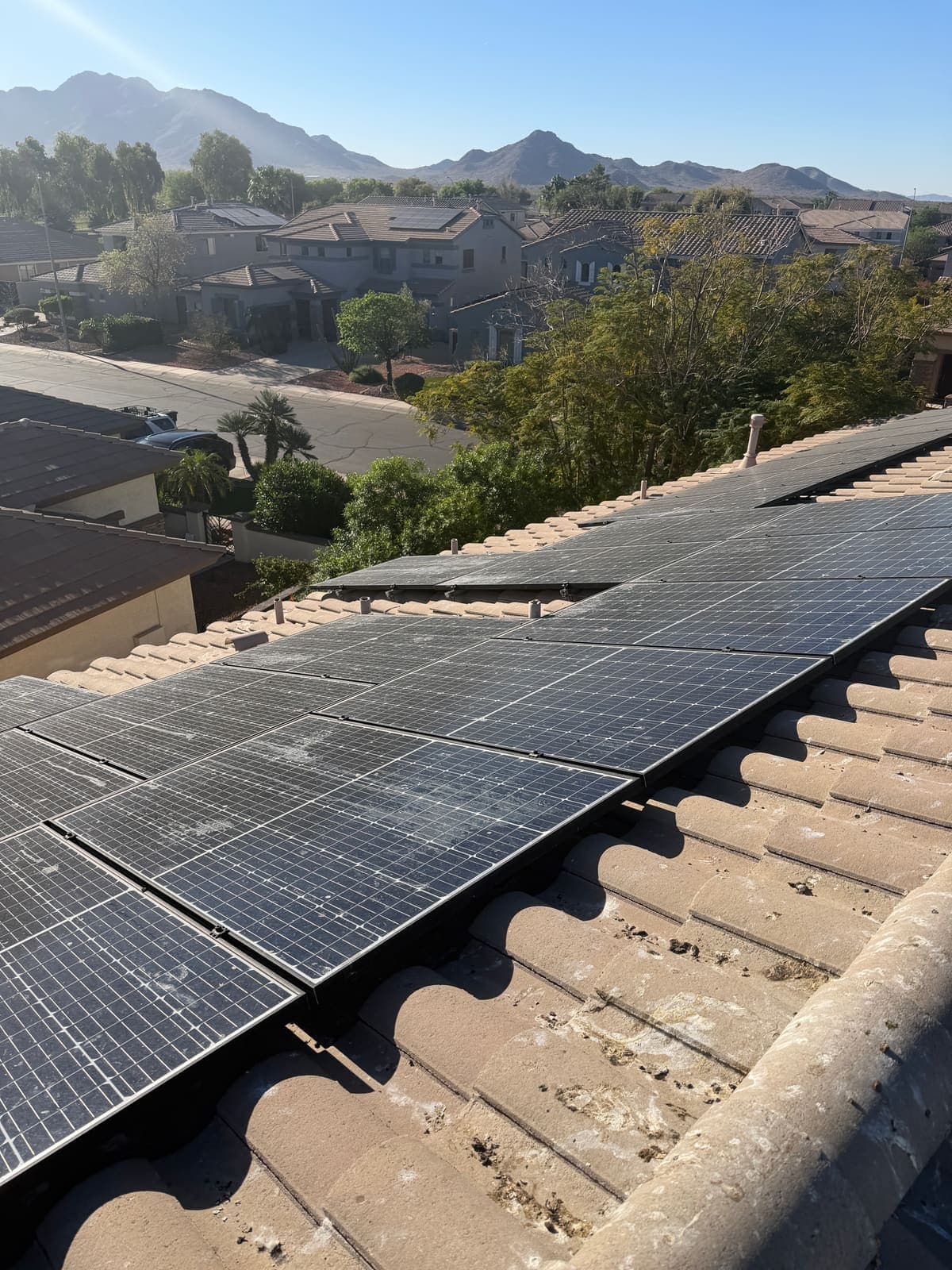
Why Your Solar Makes Less Power in Summer Than in Spring
Plenty of Arizona solar owners notice it: the longest, sunniest days of the year don't always bring the best production. Heat is usually the reason. Here's why it happens, how to read your numbers, and when a drop is worth a closer look.
“The price was in budget and they were able to accommodate our roofer's schedule.”
Suzette L. · Google Review
“I highly recommend Solar Fix for their caring approach and top-notch service!”
Melissa D. · Google Review
“Very refined process in place here with lots of communication.”
Brian G. · Google Review
The short answer
Solar panels make more power when they're cool. In an Arizona summer, panels on a roof get very hot, and that heat cuts their output. So even though June and July have the longest days, many systems here make about as much, or less, than they did in a mild, clear spring month.
That's normal. What isn't normal is a drop that's much bigger than last year's in the same month, or one part of the system falling far behind the rest.
Why heat lowers solar output
Every solar panel has a power rating, like 400 watts. That rating is measured in a lab under standard test conditions: 1000 W/m², 25°C cell temperature, and AM1.5. In plain terms, that's strong sunlight on a panel whose cells are at 77°F.
On a real roof, the cells are almost never that cool. Qcells, for example, lists a nominal module operating temperature of 109 ± 5.4 °F (43 ± 3 °C) for one of its panels. That number comes from a standard test with mild air, around 68°F, and moderate sun. On a 110°F Phoenix afternoon with the sun high overhead, panels run a lot hotter than that.
As the cells heat up, their voltage drops and the panel makes less power. Manufacturers publish how much in a number called the temperature coefficient. Most solar panel coefficients range between minus 0.20 to minus 0.50 percent per degree Celsius. One Qcells datasheet, for example, lists a temperature coefficient of Pmpp of −0.34 %/K, which means about a third of a percent less power for every degree Celsius above 25°C.
Here's an example of how that adds up. A panel with a coefficient of minus 0.35 percent, running at 65°C (149°F), is 40 degrees above its rating. That works out to about 14% less power than the label says at that moment. Real numbers vary with the panel, the wind and how the panels are mounted.
Why spring often looks better
Spring in Arizona gives panels a good combination: strong sun, clear skies and mild temperatures. The days are already long, and the panels stay closer to their rated temperature.
Summer adds more hours of light, but it also adds:
- ▸Heat. As above, hot cells make less power.
- ▸Monsoon clouds and storms. Afternoon storms can cut production on what started as a sunny day.
- ▸Dust. Dry weeks before the monsoon let dust build up on the glass. Our post on how much power dust costs in Arizona covers when that's worth worrying about.
Put together, a system can peak in late spring and then hold steady or dip through the hottest months, even with more daylight.
How to compare your numbers fairly
Comparing July to April isn't a fair test. Comparing July to last July is.
Most monitoring apps make that easy. Enphase says you can compare last month's production with the same month in the previous year to see whether output is higher or lower. SolarEdge's monitoring platform has a monthly report with comparative data of the previous month and of the same month a year before.
When you compare, keep a few things in mind:
1. Weather changes year to year. A cloudier monsoon or a hotter summer can lower a month by itself. 2. Panels age slowly. A review of field data by researchers at the National Renewable Energy Laboratory found a median degradation rate of 0.5% per year. A small drop from one year to the next is expected. 3. Your usage doesn't matter here. Look at production, not your electric bill. A bigger bill in summer is usually from air conditioning, not from the solar. Our guide on why an electric bill can still be high with solar explains that side. 4. Look at the shape of the day. On a healthy system, a clear day draws a smooth curve that peaks around midday. Flat tops, sudden drops or a late start are worth noting.
If you'd like a quick check without digging through the app, our Is my solar working? tool compares your system against an estimate for your address.
When a summer drop means something is wrong
Heat explains a modest, steady dip. It doesn't explain everything. Have the system looked at if:
- ▸Production is well below the same month last year, in similar weather.
- ▸One inverter, string or panel is far below the others in the app.
- ▸The system shuts off in the afternoon and comes back later.
- ▸The inverter shows an error code, a red light or a blank screen.
- ▸The midday curve is flat and cut off every clear day.
Inverters get hot in summer too, and many reduce their output to protect themselves when they overheat. An inverter in direct afternoon sun, or one that's starting to fail, can make a hot month look worse than it should. Our page on dealing with a faulty solar inverter in Arizona covers what that can look like.
What you can do
Most of the summer dip can't be fixed. It's physics. But a few things help you get the most out of the system and catch real problems early:
- ▸Check the app once a month. Compare against the same month last year and write down anything odd.
- ▸Look from the ground. Note heavy dust, bird droppings, nests, or anything hanging under the panels.
- ▸Keep the inverter area clear. Don't stack boxes or plants against it, so it can shed heat.
- ▸Stay off the roof. Don't climb up to hose or scrub hot panels. A solar panel maintenance visit handles cleaning safely.
If the numbers don't add up, a solar panel inspection checks the panels, wiring, mounts and inverter together, and anything broken goes through solar repair.
The bottom line
A lower summer number usually means your panels are hot, not broken. Arizona heat, monsoon clouds and dust can keep a system from beating its spring months even with more daylight. Compare each month with the same month last year, watch for one part of the system falling behind, and have a licensed solar technician look at it if the drop is bigger than the weather explains.
FAQ
Is it normal for solar to produce less in July than in April?+
Often, yes. Panels lose output as they get hotter, so in an Arizona summer the extra daylight can be partly cancelled out by heat, dust and monsoon clouds. The fair test is to compare a month with the same month last year, not with the spring before it.
Can I cool my panels down to get more power?+
We don't recommend spraying panels on a hot day. Cold water on hot glass is a risk, getting on the roof is a risk, and any gain fades quickly once the water dries. Panels that are mounted with an air gap underneath stay cooler on their own.
How much lower is too low?+
There's no single number from the manufacturers. If production is well below the same month last year in similar weather, or one part of the system is far behind the rest, have it checked.
Related: Is my solar working? · How to verify your solar panels are working · How much power dust costs in Arizona · Solar panel inspection · Solar repair
Not sure if your summer numbers are normal?
Send SolarFIX a screenshot of your monitoring app showing this month and the same month last year, plus your address so we can see the roof. We'll help you figure out whether it's the heat or something that needs a visit.